


Online store builders with your own domain in India (2026): what is included and what you pay
The short answer: no store builder gives you a domain for nothing, forever. The name itself, yourbrand.com or yourbrand.in, is rented by the year from a company called a registrar, which our earlier guides put at about ₹800 to ₹1,500 a year. What the builder charges for is the right to put your store on that name, and nearly every builder puts that on a paid plan. On SitesPlaced it is part of the Starter plan at ₹199/month or ₹1,990/year, with no extra charge for connecting; the free plan lives on a free address like yourbrand.sitesplaced.site with a small SitesPlaced badge. A “free domain” offer usually means the first year, bundled with a yearly plan, and then the registrar’s renewal price.
This guide explains the words on the settings page in plain English, says why a store on its own name is easier to trust, lists which builders include the domain and which charge separately, and walks through connecting one.
Key takeaway: a store on its own domain costs two things, the name from a registrar and a plan from the builder, and nothing else. On SitesPlaced that is an example ₹1,000 a year for the name plus ₹1,990 a year for Starter, about ₹250 a month, and it also removes the badge and makes store pages answer about 4× faster than on the free plan. Start on the free address, prove the store sells, then put your name on it. Buy the name from a registrar you can log into, not from the platform, so you keep it if you ever move.
TL;DR
- • A domain is the name people type. You rent it yearly from a registrar; the store builder does not own it and mostly does not sell it.
- • A subdomain like yourbrand.sitesplaced.site is free and takes orders today. It carries the platform’s name and stays with the platform.
- • SSL and DNS are the padlock and the address book. Neither should cost you anything extra on a modern builder.
- • Trust is why a store on its own name sells more of the visitors it gets. It does not bring visitors by itself.
- • Which builders include it: SitesPlaced from Starter at ₹199/month; WSTORES on Pro at ₹499/month; Shop2Host as an add-on to Pro; StartupInMinutes, FlexiCommerce and StoreMaker on their ₹499 to ₹999 plans, all as of August 2026. Prices change; check each page.
What a domain actually is
A domain is the name of your store on the internet: the thing a buyer types, sees in a WhatsApp forward, or reads off your packaging. yourbrand.com is a domain. So is yourbrand.in. You do not buy it outright; you rent it, usually a year at a time, from a registrar, and it stays yours as long as you keep renewing. If you stop, it goes back on sale and anyone can take it.
The domain and the store are two separate things. The store, its pages, products, cart and orders, lives on the builder’s computers. The domain is only a signpost that tells the internet where to send people who type that name. Connecting a domain to a store means changing the signpost. Nothing moves: the name stays registered where you bought it, and the store stays where it is.
Because the two are separate, you can point the same name at a different store later, or move a name from one site to another, without losing either. That separation is the whole reason a domain is worth paying for, and we come back to it below.
Subdomain vs your own domain
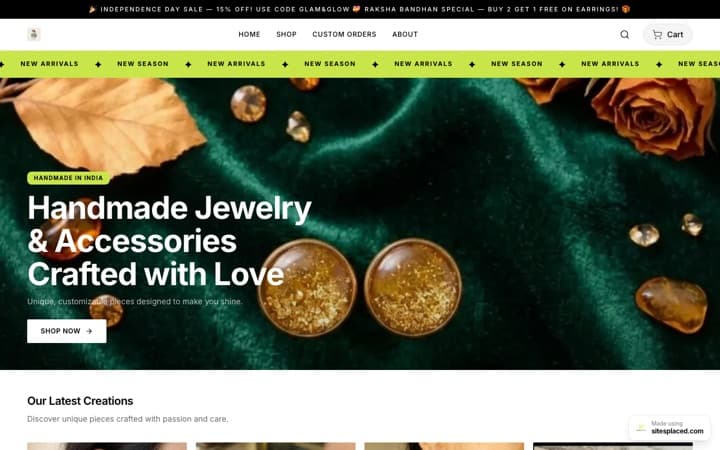
A subdomain is a name inside someone else’s name. yourbrand.sitesplaced.site is your name, then the platform’s. Every builder with a free plan gives you one, because the platform already owns the parent name and can hand out names under it instantly, with no registrar involved. It is a real address: it opens on every phone, it has the padlock, and on SitesPlaced it takes orders with UPI, cash on delivery and WhatsApp checkout. Plenty of sellers run on it for months.
Your own domain is a name you registered yourself, with nobody else’s brand in it. The differences that matter to a seller are these:
| Free subdomain | Your own domain | |
|---|---|---|
| What it costs | ₹0 | About ₹800 to ₹1,500 a year from a registrar, plus a plan that lets you connect it |
| How it reads to a buyer | Your name, then the platform’s name | Your name only |
| Who owns it | The platform; it works while your store is published there | You, for as long as you renew it |
| If you change platform | The address is gone; printed QR codes and old links stop working | You point the same name at the new store; links keep working |
| Business email | Not possible; you use Gmail or similar | orders@yourbrand.com, through a separate mailbox service |
| Time to set up | Instant, on publish | About five minutes of work, then minutes to a few hours to spread |
| HTTPS (the padlock) | Included | Included; issued automatically once the records are live |
| The SitesPlaced badge | Shown on the free plan | Removed, because the same plan covers both |
SitesPlaced facts as published on 30 September 2026. The domain price is the range from our earlier guides; registrars differ.
Who sells domains, and what you pay
Registrars sell domains. GoDaddy, Hostinger, Namecheap, BigRock and Cloudflare are the examples our help centre names; there are many more, and any of them is fine as long as you can log in and edit the domain’s settings yourself. That login is the thing you are really buying. Our earlier guides put a .com or .in at about ₹800 to ₹1,500 a year; we are not repeating registrar price lists here because they change weekly, and because the number that matters is the renewal price, not the first-year offer. A very cheap first year that renews at several times the amount is a common pattern. Look up year two before you pay for year one.
Some builders sell domains too, inside their dashboard. WSTORES lists that on its Pro plan as of August 2026. It is convenient, and there is nothing wrong with it, provided you check two things first: that the domain will be registered in your name, and that you can transfer it out if you leave. A name registered to the platform, or one you cannot move, is a subdomain with a nicer spelling.
SitesPlaced does not sell domains. You buy the name wherever you like and connect it; there is no charge for connecting on Starter and above, and no markup on the name because we never touch it. Choosing between .com and .in, what to do when the name is taken, and how to check a name for trademark trouble are covered in how to choose a name and domain for your online store, so we will not repeat that here.
SSL, DNS and the other words on the settings page
DNS is the internet’s address book. When a buyer types yourbrand.com, their phone asks the address book where that name lives and gets back a set of records. Connecting a domain means adding a few records to that book. Three come up: an A record, which sends the bare name (yourbrand.com) to the store’s address; a CNAME, which sends the www version to the same place; and a TXT record, a short line of text that proves to the builder that the domain is yours. Your builder gives you the exact values; you paste them at your registrar.
Propagation is the wait after you add the records. Address books around the internet keep copies and refresh them on their own schedule, so a change can take minutes or, occasionally, a day or two to be seen everywhere. Nothing you or the builder does speeds it up. The most common mistake is deciding after ten minutes that it is broken, editing the records again, and starting the clock over.
SSL, also written as HTTPS, is the padlock in the browser bar. It means the connection between the buyer’s phone and your store is encrypted, and it is what stops a browser from labelling your store “not secure” at the moment a buyer is typing a card number. On any modern builder the certificate is issued for you, automatically, once the DNS records are live, and you should not be paying for it separately. SitesPlaced issues it for both yourbrand.com and www.yourbrand.com. A warning in the first minutes after you add the records is normal; one that lasts for hours usually means an old record is still pointing at a parking page.
Verification is the builder checking the address book and confirming the records point at it. On SitesPlaced the domain reads “verified and active” once the A record or CNAME is in place; a TXT record alone proves ownership but does not send any visitors, so the badge stays on pending until the routing record is there. The step-by-step, with the mistakes that take a store offline, is in how to connect a custom domain to your ecommerce website.
Why a store on its own domain sells more of its visitors
We are not going to give you a percentage, because we do not have one that is honest. What we can do is walk through what a first-time buyer sees, because that is where the difference is.
A buyer who has never heard of you meets your store as a link: in a WhatsApp forward from a friend, in an Instagram bio, in a Google result. The link is the first thing they read, before a single photo loads. A name that is only your brand reads as a business that exists on its own. A name with a platform’s brand in it reads as something set up on a platform, which is true, and which a cautious buyer files under “new”. Neither is a lie. One of them starts the visit with a question the other does not.
The same name then has to hold up across everything the buyer touches. Your Instagram handle, the address on the box, the sender of the order email, the name on the invoice, the link in the ad. When they all match, the store reads as one business. When the packaging says yourbrand and the link says yourbrand-something-else, the buyer has to do a small piece of work to connect them, and doubt lives in that gap. A domain is the only way to make the link match the rest.
Three practical things follow from having your own name. You can have business email, orders@yourbrand.com instead of a personal Gmail on every invoice, which is a separate mailbox purchase but impossible without the domain. You can print the address on packaging, cards and a QR code without worrying that a platform address might change. And when you run ads, the destination reads as a brand; on SitesPlaced the same Starter plan that unlocks the domain also removes the badge and adds Meta Pixel with the Conversions API, so the ad, the landing page and the tracking all sit on your name.
The quiet one is ownership. Every link you earn, every listing, every QR code you print points at the name. If the name is a platform subdomain, all of that belongs to the platform the day you move. If the name is yours, you change one signpost and keep the lot. Sellers rarely think about this in month one and always think about it in month eighteen.
The limit is just as important. A domain does not bring anyone to the store. A store nobody visits does not sell more on a .com. It converts more of the visitors you already have, by removing a reason to hesitate, and that is worth exactly as much as your visitor count. The fuller case, with the other trust fixes that cost nothing, is in how a custom domain increases sales and how to make customers trust your online store.
Which builders include a domain, and which charge separately
Two different questions hide inside “does the builder include a domain”. The first is whether you can connect a name you own, and on which plan. The second is whether the builder sells or gives you the name itself. The table answers both, using only facts we have already published, with the date of each. “Not listed” means the pricing page did not mention it when we looked, not that the feature is missing. Prices change; check the builder’s own pricing page before you decide.
| Builder | Connecting your own domain | Sells or bundles the name? | Source date |
|---|---|---|---|
| SitesPlaced | Connecting your own domain is included on Starter (₹199/month or ₹1,990/year) and every plan above; the free plan lives on yourbrand.sitesplaced.site | No. You buy the name from any registrar and connect it; no extra charge for connecting | Published prices, 30 September 2026 |
| Shopify | Custom domains on its plans; Basic listed at ₹1,994/month billed monthly or ₹1,499/month billed yearly | Listed as a paid add-on in our 2026 comparison | India pricing page, September 2026 |
| Squarespace | Custom domain on paid plans | Listed a domain free for the first year, then paid, in our 2026 comparison | Approximate, 2026 |
| Wix | Custom domain on paid plans | Check their current plan page | Approximate, 2026 |
| Dukaan | Custom domain on paid tiers | Check their current plan page | Approximate, 2026 |
| WSTORES | On Pro at ₹499/month; not on Basic at ₹399/month; ₹5,999 once for 3 years, GST included | Yes, a domain can be bought inside the dashboard | Pricing page, August 2026 |
| Shop2Host | Add-on on Pro at ₹690/month or ₹586/month billed annually | Not listed | Pricing page, August 2026 |
| StartupInMinutes | On Pro at ₹999/month | Not listed | Pricing page, August 2026 |
| FlexiCommerce | From ₹999/month | Not listed | Pricing page, August 2026 |
| StoreMaker | On Growth at ₹499/month | Not listed | Pricing page, August 2026 |
| Shopexer, StoreBase | Not listed on their pricing pages when we checked | Not listed | August 2026 |
Shopify plan prices from its India pricing page, September 2026; its domain row, and the Squarespace, Wix and Dukaan rows, are from our 2026 comparison and are approximate. WSTORES and the six other Indian builders are from their pricing pages, August 2026. Taxes may apply where a price is not marked as inclusive.
Read across the Indian builders and the pattern is the same everywhere: the domain sits on the second plan, not the first. WSTORES puts it on Pro rather than Basic, Shop2Host on Pro rather than free, StoreMaker on Growth rather than Starter. SitesPlaced puts it on its first paid plan, Starter, because the domain is the first thing a store pays for once it knows it will stay open. The full plan-by-plan comparison of the same builders, on everything other than the domain, is in Indian online store builders compared.
What “free domain” usually means
The search “ecommerce website builder with free domain” deserves a straight answer. In our 2026 comparison the one builder that listed a free domain, Squarespace, listed it as free for the first year and then paid. That is the usual shape of the offer on international builders: the name is bundled into a yearly plan, and from year two the registrar’s renewal price applies. It is a discount, not a free domain, and it is only a good discount if you would have bought the yearly plan anyway.
Three questions turn a free-domain offer into a real number. Is it free in year one only? Which plan does it require, and is that plan yearly? And is the name registered to you, so that you can take it elsewhere? If the answers are yes, yearly and no, the honest price of the domain is the plan you would not otherwise have bought.
SitesPlaced does not offer a free domain, and we would rather say so than dress up a first-year discount. What we do is charge nothing for the connection and nothing on top of the name. An example ₹1,000 a year for the name plus ₹1,990 a year for Starter is ₹2,990, about ₹250 a month, for a store on its own name with the badge gone. Paid monthly instead, Starter is ₹199 × 12 = ₹2,388, so ₹3,388 with the name. What the rest of a store costs, gateway fees, packaging, couriers, is worked through in online store builder pricing in India.
How it works on SitesPlaced, step by step
The order matters, so here it is in the order that avoids paying for anything you do not need yet.
- Publish first, on the free address. Pick a short store link under Settings → Store details; that becomes yourbrand.sitesplaced.site. Take a test order, check WhatsApp checkout and the product pages. A domain only serves a published store, and the free address is the quickest way to find out whether the store works before you spend on a name.
- Buy the domain from a registrar. Keep the registrar login handy; you will need it in step four.
- Upgrade to Starter. ₹199/month or ₹1,990/year. The code FREE7 gives 7 days free with autopay, which is enough time to connect and test; cancel before the first charge and you pay nothing. The one-time ₹99 Student unlock covers student portfolios only and will not attach a domain to a store.
- Type the domain into Settings → Store details → Custom domain and save. With or without www, either works. The badge changes to “Pending DNS verification” and a panel opens with what to do next.
- Connect, one of two ways. If your DNS provider supports the Domain Connect standard for SitesPlaced, the panel starts with “Automatic setup available” and a “Connect automatically with …” button: you sign in at your registrar in a popup, approve the records, and SitesPlaced writes them for you. Whether that button appears depends on your provider having switched on SitesPlaced’s setup template, not on anything you do, and the manual records are always shown underneath. The manual route is three records to copy, with instructions matched to your registrar; SitesPlaced detects GoDaddy, Cloudflare, Namecheap, Hostinger, BigRock, IONOS and others and shows the steps as they appear there. About five minutes.
- Click Check Verification Now. Once the badge reads “yourbrand.com is verified and active”, both yourbrand.com and www.yourbrand.com open your store with HTTPS. Your dashboard’s share links and the QR code on the Home tab switch to the new address, and search engines are pointed at it.
- Tell people. Update your Instagram bio, WhatsApp catalogue and anything printed. Old links keep working, because the free address stays live alongside the domain, so there is no rush.
Four things worth knowing before you start. Each site or store takes one domain, so two stores need two names. Changing the domain restarts verification. Removing a domain is one click, the store falls back to the free address at once, and the name can then be attached to a different site. And adding, changing or re-verifying a domain needs an active plan that covers the store, so renew before you touch domain settings. If you use Cloudflare, set the new records to “DNS only”, the grey cloud; the orange proxied setting breaks HTTPS.
The same Starter plan also removes the SitesPlaced badge, adds visitor and store analytics and Meta Pixel with the Conversions API, and comes with a dedicated setup person who will connect the domain for you if you would rather not. Store pages on Starter and above also answer about 4× faster than on the free plan: about 75 ms instead of about 330 ms, measured on live paid stores on 28 September 2026. “Answer” is how quickly a page starts arriving on the shopper’s phone, before the photos load, and it matters most when a buyer taps a link on mobile data. Details in why paid stores answer 4× faster. Already selling from Instagram? The specific case of moving a link-in-bio store onto a domain is in a custom domain for your Instagram store.
When to wait, and when to do it
Wait if you are in your first weeks and still finding out whether anything sells, if your buyers are people who already know you and will order from a WhatsApp link regardless, or if the store is for one season and will close afterwards. The free address does everything those stores need.
Do it the week you print anything with the address on it, the week you first pay for an ad, the day you set up a Google Business Profile for the store, or when you start selling to shops, offices or anyone who will judge you by your email address. From then on, every rupee you spend on reaching people accumulates to a name you keep.
Who should not pick SitesPlaced for this. If you want to buy the name inside the same dashboard as the store, we do not sell domains; WSTORES lists that on its Pro plan as of August 2026. If you need a marketplace’s built-in shoppers, no builder’s domain replaces them. We have verified everything here for Indian sellers; sellers elsewhere should check the integrations page for their gateway and courier before deciding.
Frequently asked questions
Do I need to buy a domain to open an online store in India?
No. On SitesPlaced every published store gets a free address like yourbrand.sitesplaced.site that works on every phone, has HTTPS and can take orders with UPI, cash on delivery and WhatsApp checkout. Your own domain is a step you take when the store is worth putting your name on: when you print packaging, run ads or plan to keep selling past the first season.
Is there an ecommerce website builder with a free domain in India?
Be careful with the phrase. In our 2026 comparison, Squarespace listed a domain free for the first year and then paid, which is the usual shape of a free-domain offer: the first year is bundled with a yearly plan and the renewal is charged at the registrar’s price. Among the Indian builders we compared in August 2026, the domain sat on a paid plan wherever it was listed at all; WSTORES lets you buy one inside its dashboard on the ₹499/month Pro plan. SitesPlaced does not sell domains and does not charge for connecting one. Check each builder’s current plan page, and read the renewal price before you count a domain as free.
How much does a domain cost in India?
Our earlier guides put a .com or .in at about ₹800 to ₹1,500 a year from a registrar, depending on the registrar and the name. First-year offers can be much lower and renew much higher, so look up the renewal price before you buy. The domain is paid to the registrar, not to SitesPlaced.
Can I connect my own domain on the free SitesPlaced plan?
No. Connecting a domain is on the Starter plan, ₹199/month or ₹1,990/year, and every plan above it. The same plan removes the SitesPlaced badge and makes store pages answer about 4× faster than on the free plan. The code FREE7 gives 7 days free on Starter or Growth when you set up autopay, which is enough time to connect the domain and test it; cancel before the first charge and you pay nothing.
How do I connect my domain to my online store?
On SitesPlaced: publish the store, buy the domain from any registrar, upgrade to Starter, then type the domain into Settings → Store details → Custom domain and save. If your DNS provider supports one-click setup for SitesPlaced, a Connect automatically button appears; otherwise the panel shows the exact records to add at your registrar, an A record for yourbrand.com, a CNAME for www and a TXT record that proves the domain is yours, with instructions matched to your registrar. Click Check Verification Now, and once the badge reads verified and active, both yourbrand.com and www.yourbrand.com open your store with HTTPS.
How long does it take for my domain to work?
Adding the records takes about five minutes. After that the change has to spread across the internet, which the SitesPlaced dashboard describes as 5 minutes to 48 hours; most domains verify within an hour. Your free address keeps working the whole time, so the store is never offline. If it has not verified after a day, re-check the records against the on-screen table; an old record still pointing at a parking page is the usual cause.
Do I have to pay for SSL or HTTPS separately?
No. On SitesPlaced the certificate that gives your store the padlock is issued automatically once your domain’s records are live, for both yourbrand.com and www.yourbrand.com. A browser warning during the first minutes after you add the records is expected; one that persists for hours usually means an old record is still pointing elsewhere.
Can I keep my domain if I leave the platform?
If the domain is registered in your name at a registrar you can log into, yes: you change its records to point at the new store and every link, QR code and listing keeps working. That is the main reason to buy from a registrar rather than to rely on a platform address. If a builder sold you the domain, check before you buy whether you can transfer it out.
Verdict
Treat the domain as two purchases and judge each on its own. The name: buy it from a registrar you can log into, in your own name, and read the renewal price. The connection: pick a builder that puts it on the plan you would buy anyway, charges nothing extra for it, and issues HTTPS for you. On that test, SitesPlaced is the straightforward choice for a small Indian store: publish free on yourbrand.sitesplaced.site, then ₹199/month or ₹1,990/year for your name on it, the badge gone and pages that answer about 4× faster, with no domain markup because we never sell the name. Of the other Indian builders we have compared, WSTORES is the one to look at if you want the name and the store bought in one place.
Whichever you choose, do not let the domain delay the store. Publish, sell, then put your name on the door.
Publish free, add your name when it is worth it
Open a free store on yourbrand.sitesplaced.site with UPI, cash on delivery and WhatsApp checkout at 0% commission. Connect your own domain on Starter, ₹199/month, whenever you are ready.
Related reading
- How to connect a custom domain to your ecommerce website
- How to choose a name and domain for your online store
- How a custom domain increases sales and trust
- Online store builder pricing in India (2026)
- How to make customers trust your online store
- Indian online store builders compared (2026)
- Best online store builder for beginners (2026)